

The Weapon Everyone Has Access To
Most of us will never commit murder. Most of us will never steal from an orphan. Most of us will never deliberately deal in Riba or destroy an entire family through financial exploitation.
But every single one of us carries a weapon we use every single day. Sometimes carelessly. Sometimes deliberately. Sometimes, without even realising the damage it is doing.
That weapon is our tongue. And the twelfth greater sin is one of the most devastating things that tongue can do — falsely accusing an innocent person of sexual immorality.
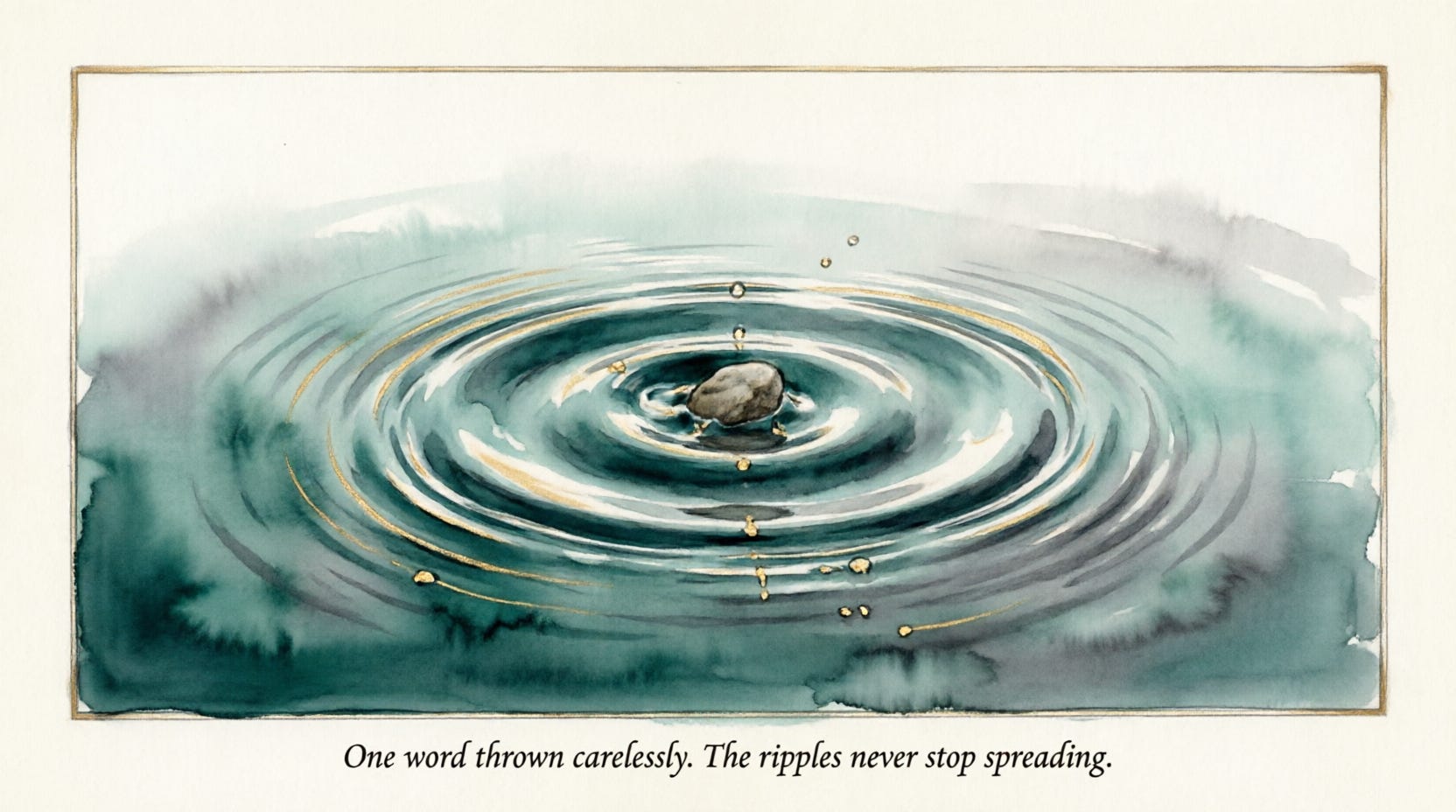
Qadhf (قذف) — the word literally means to hurl or to throw. And that image is perfect. Because when you accuse an innocent person of Zina, you are hurling something at them — something that sticks, that spreads, that follows them, that can destroy their reputation, their marriage, their family, their entire life — in a single moment, with a single sentence.
And Allah takes it very, very seriously.
What Exactly Is Qadhf?
The twelfth greater sin is Qadhf — wrongfully accusing a chaste Muslim man or woman of adultery or homosexuality. This is confirmed by the Holy Prophet (S), Imam Ja’far as-Sadiq (AS), Imam Musa al-Kadhim (AS), and other Imams of the Ahlul Bayt (AS).
Linguistically, Qadhf means to throw, and in Islamic law, it signifies the act of throwing slander at a person to destroy their honour. According to the consensus of Islamic scholarship, it is a grave sin and specific legal crime of falsely accuse a chaste Muslim of unlawful sexual intercourse without the backing of four qualified eyewitnesses.
Notice the precision in that definition. It is not just any false accusation. It is specifically the accusation of Zina — sexual immorality — directed at a chaste person. Why is this sin singled out so specifically? Because of all the accusations that can be made against a human being, the accusation of sexual immorality is uniquely destructive to their dignity, their relationships, and their standing in the community. It strikes at the most intimate, personal, and vulnerable aspects of a person’s life.
And Islam — a faith that guards human dignity as one of its foundational principles — responds to this attack with one of its most severe prohibitions.
The Verse That Changed History
The revelation of the Quranic verses on Qadhf did not come in abstract. It came in response to a real event — one of the most painful episodes in the life of the Prophet’s household (S) — an event that tore through the early Muslim community and left wounds that took time to heal.
In Surah an-Nur, Chapter 24, The Light, Verse 4, Allah declares:
“And those who accuse chaste women and do not produce four witnesses — flog them with eighty lashes and do not accept their testimony ever after. Those are the defiantly disobedient.”
Three separate consequences are packed into one verse. Eighty lashes. Permanent rejection of testimony. The designation of fasiq — transgressor. This stringent law serves primarily to protect individual honour and safeguard the fabric of society from suspicion and discord.
And then in Surah an-Nur, Chapter 24, The Light, Verse 23, Allah goes further:
“Indeed, those who falsely accuse chaste, unaware, believing women are cursed in this world and the Hereafter — and they will have a great punishment.”
Cursed. In this world AND the next. Not just punished — cursed. The Arabic word lu’ina carries the meaning of being removed from Allah’s mercy. It is one of the most serious descriptions in the Quran of a person’s spiritual state.
Committing Qadhf without repentance incurs a curse from Allah in this life and the hereafter, highlighting its profound gravity as a sin against both the individual and the community.
What the Ahlul Bayt (AS) Taught
The Imams (AS) spoke about this sin with particular gravity — because they understood, intimately, what it means to have one’s honour attacked unjustly. The Ahlul Bayt themselves were not immune to the tongues of their enemies. They knew the pain of false accusation from lived experience.
The Holy Prophet (S) listed Qadhf among the seven most destructive sins — the mubiqa’t — the sins that bring absolute ruin. He said:
“Avoid the seven destructive sins — Shirk, magic, murder, devouring Riba, consuming the orphan’s property, fleeing from battle, and accusing chaste believing women of immorality.”
Seven. And Qadhf sits in that list alongside Shirk and murder. That alone tells us everything we need to know about how seriously the Prophet regarded a person’s honour.
Imam Ja’far as-Sadiq (AS) said:
“Whoever accuses a believer of something in order to disgrace them and damage their reputation — Allah will resurrect that person on the Day of Judgement on the Bridge of Hell until they have come out of what they said.”
Not a symbolic punishment. A literal, prolonged reckoning — suspended over Hell until the account is settled.
And Imam Ali (AS) in Nahj al-Balagha taught a principle that goes to the very heart of this sin:
“The tongue of the believer is behind their heart. When they want to speak, they think first. But the tongue of the hypocrite is in front of their heart — they speak before they think.”
A believer considers before they speak. A believer asks: Is this true? Do I know this for certain? What will these words do to this person? And if the answers are uncertain, they stay silent.
This Is the Age of Qadhf
If there is a single sin in this series that feels most urgently relevant to the world we are living in right now, it is this one.
We live in the age of social media, where an accusation can reach ten thousand people before the accused has even woken up in the morning. Where screenshots are shared without context. Where rumours dressed as concern spread through WhatsApp groups at the speed of light. Where a person’s reputation — built over a lifetime — can be dismantled in an afternoon by someone with a phone and a grievance.
The Quran required four witnesses for a Qadhf accusation to be legally valid. Four. Eyewitnesses. People of unimpeachable character. All four in agreement. This is not a bureaucratic hurdle — it is a profound statement about how seriously Islam regards the presumption of innocence and the protection of honour.
We live in a time where a single anonymous account, a single forwarded message, a single rumour whispered into the right ears, is treated as sufficient evidence to destroy someone. And the Muslim community is not immune to this. Our group chats, our community forums, our majlis conversations — all of them can become vehicles for Qadhf if we are not deeply, carefully conscious of what we are saying and what we are spreading.
The Prophet (S) said:
“It is enough of a lie for a person to narrate everything they hear.”
Everything they hear. Without verification. Without consideration. Just passing on what arrived — because it arrived.
That, in the age of instant messaging, is a warning that could not be more timely.

The Unique Destruction of Sexual Slander
Ayatollah Dastaghaib Shirazi explains why Qadhf — specifically the accusation of Zina — is treated with such severity above other forms of slander.
When you falsely accuse someone of theft, you damage their trustworthiness. When you falsely accuse someone of cowardice, you damage their courage. These are serious. But when you falsely accuse someone of sexual immorality, you attack something far deeper and far more irreparable.
You potentially destroy their marriage. You plant doubt in their spouse’s heart that may never fully leave. You damage their relationship with their children, their parents, and their community. You strip away the most intimate aspects of their dignity and expose them — falsely — to public shame. You take something that exists only in your imagination and weaponise it against a real human life.
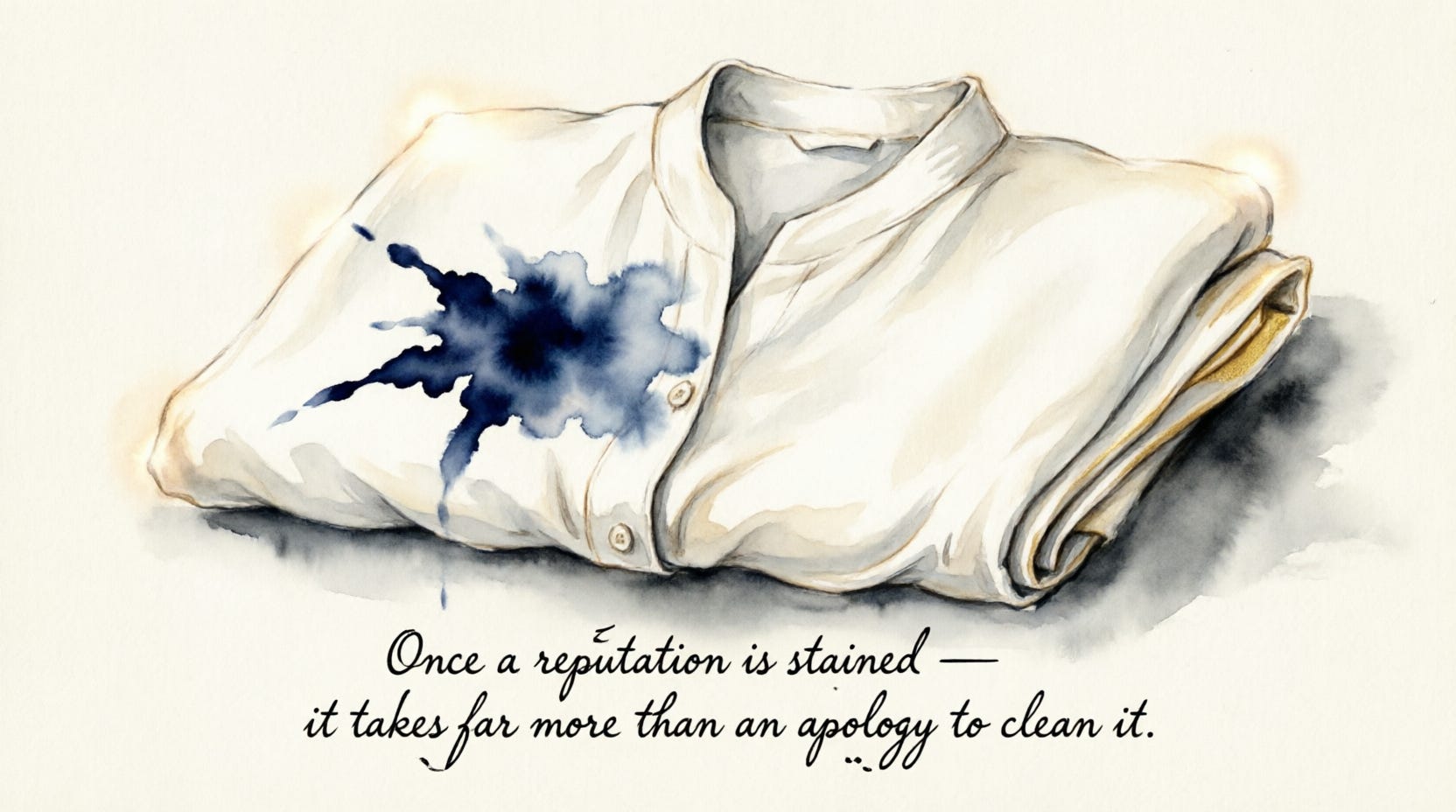
And the particularly cruel irony is that once such an accusation is made, the accused is placed in the impossible position of having to prove a negative. How do you prove that you did not do something? The burden shifts. The reputation is already stained. And even if they are fully cleared, some people will always remember the accusation more clearly than the exoneration.
This is why Allah did not simply prohibit Qadhf. He cursed it.
What About True Accusations?
The natural question arises — what if the accusation is true? What if someone genuinely witnessed something or has genuine evidence?
Islam’s answer is precise and demanding. If you have witnessed something unlawful, the correct Islamic response is not to spread it in the community, not to share it on group chats, not to whisper it to mutual friends. The correct response is to bring it through the proper legal and judicial channels — with the full weight of evidence required — and let the appropriate authorities handle it.
The Quran in Surah an-Nur, Chapter 24, The Light, Verse 5 provides an exception for those who repent and reform, allowing for the restoration of their moral status — but this exception applies to the accuser, not to a licence for casual accusation.
What Islam absolutely does not permit is using a person’s real sin — even a genuine one — as gossip. As community entertainment. As a reason to publicly destroy their reputation in the absence of a proper process. The sin of the accused does not give the community permission to run with it.
And if you are wrong — if your accusation turns out to be false, or your evidence insufficient — you become the one carrying the sin of Qadhf, with all its weight and all its curse.
The Connection to the Previous Sins
Notice something beautiful and sobering about the ordering of these greater sins. We moved from Zina in Sin 10 — the actual act — to Qadhf in Sin 12 — the false accusation of that act. Islam is telling us something profound here.
Committing Zina is a greater sin. But so is falsely accusing someone of it. The honour of the innocent person and the honour of the guilty person occupy the same space in Islamic law when it comes to how accusations are handled. The law does not say: if they are guilty, you can say whatever you like. It says: without four witnesses, you do not speak. Full stop.
This is a remarkable civilisational principle. In a world that runs on accusation — where being accused is often treated as equivalent to being convicted — Islam places an enormous, protective wall around the presumption of innocence. And it places an equally enormous warning on the lips of anyone thinking of tearing that wall down with an unfounded word.
How Do We Guard Against This Sin?
Verify before you share. In the Quran, Surah al-Hujurat, Chapter 49, The Private Chambers, Verse 6 commands:
“O you who believe — if a transgressor brings you news, verify it, lest you harm a people out of ignorance and then regret what you have done.”
This verse was revealed fourteen centuries ago. It reads like it was written for WhatsApp.
Ask yourself three questions before speaking about another person. Is it true? Is it necessary? Is it kind? If it fails any one of these — stop.
Remember the weight of honour in Islam:
The Prophet (S) said in his final sermon — one of the most sacred moments in Islamic history —
“Your blood, your wealth, and your honour are sacred to one another, as sacred as this day, this month, and this city.”
Honour is placed beside blood and wealth. It is not a small thing. It is a protected right.
Be especially careful in community settings:
The majlis, the community centre, the sisters’ halaqah, the brothers’ group chat — these spaces can become breeding grounds for Qadhf if consciousness is low. You are not obligated to share everything you have heard about everyone you know. In fact, you are often obligated to stay silent.
Make dua for the protection of your tongue:
Imam Ali al-Sajjad (AS) in Sahifa Sajjadiyya has a beautiful dua specifically asking Allah to protect him from the sins of the tongue — to guard it from speaking what should not be spoken, and to bless it only with what is true and what is good. It is a dua worth memorising and repeating daily.
A Closing Thought
In the last three articles, we have talked about Zina, sodomy, and now Qadhf — three sins that all revolve around the same theme: the sacredness of human intimacy, human dignity, and human honour. Islam protects these things from two directions. It prohibits the actual violations — the acts themselves. And it prohibits the reputational violations — the false accusations, the spreading of slander, the weaponising of sexual shame against innocent people.
The believer who takes this seriously is not just avoiding a legal penalty. They are embodying something profound — a deep respect for the sanctity of every human being they share this world with. A recognition that behind every name being discussed in a group chat, behind every rumour being passed along, behind every accusation thrown carelessly, there is a real person. A soul created and loved by Allah. A person whose honour Allah declared as sacred as their life.
Guard your tongue. Not because words are small. But because they are not.
May Allah protect our tongues from slander, our ears from welcoming it, and our hearts from finding any satisfaction in the destruction of another person’s reputation. And may He make us people in whose presence others feel safe — knowing that what they share with us will go no further than our own hearts. Ameen.