

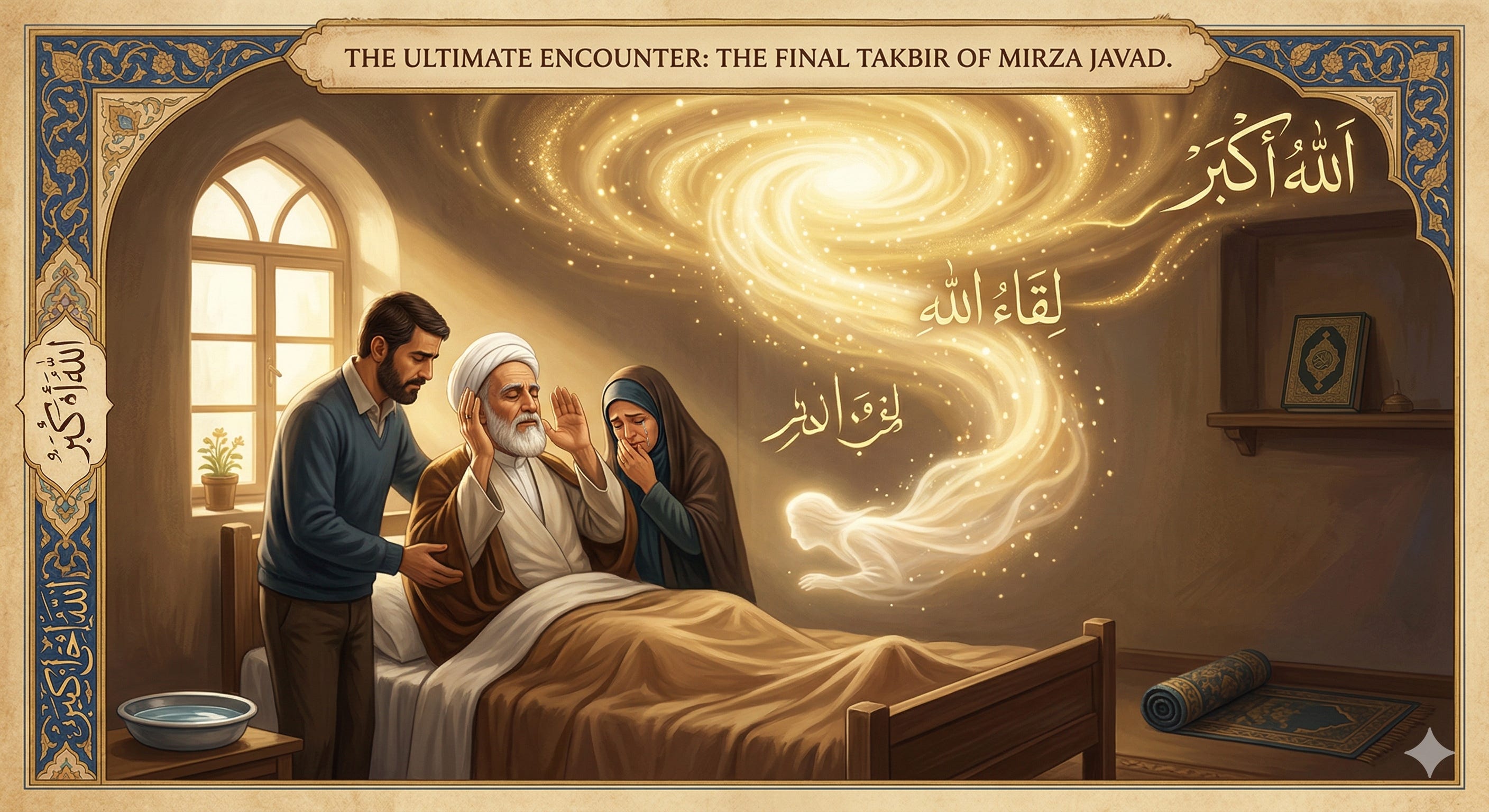
In his most profound book, Liqa’ Allah (The Encounter with God), Mirza Javad Maliki Tabrizi argued fiercely that meeting the Creator is not an event delayed entirely until the afterlife. He taught that a true spiritual traveller prepares for this encounter with every breath, every conscious thought, and every act of worship.
It is fitting, then, that the story of his own passing from this world perfectly mirrored the core message of his life’s work. He did not just write about the ultimate meeting; his final moments on earth became a legendary demonstration of it.
The Final Day
It was the 11th day of the Islamic month of Dhu al-Hijjah in the year 1343 AH (1925 CE). This date holds deep spiritual significance, falling right in the middle of the Hajj season—a time dedicated to stripping away worldly attachments and returning to the house of God.
Mirza Javad was gravely ill. His body, worn down by years of rigorous spiritual discipline, teaching, and age, was finally giving out. He was confined to his bed, too weak to move about. Yet, as the time for the midday prayer (Dhuhr) approached, his spiritual vigilance remained as sharp as ever.
Preparation for the Court of the King
Despite his severe weakness, Mirza Javad refused to approach his daily prayer with anything less than absolute presence. He asked his family to bring water to his bed so he could perform his ritual ablution (wudhu).
With whatever strength he had left, he washed himself, purifying his physical form one last time. He then asked to be helped to sit up and face the Qiblah (the direction of prayer).
The Departure at the Threshold
In Islamic prayer, the worshiper physically and spiritually leaves the material world behind by raising their hands and declaring “Allahu Akbar” (God is Greater). This is the Takbirat al-Ihram—the sacred threshold that prohibits all worldly actions and thoughts, locking the believer entirely in the presence of the Divine.
Sitting in his bed, facing the Qiblah, Mirza Javad raised his trembling hands. He brought them beside his ears and uttered the words: “Allahu Akbar.”
Before he could proceed to recite the next verse, his soul slipped away. He passed from this world exactly at the threshold of the prayer, leaving his physical body right as his spirit entered the absolute presence of the Beloved.
The Irfani Reality
To scholars and students of mysticism, this was no coincidence. It was the ultimate seal of authenticity on his life:
The Reality of Liqa’ Allah: He spent his entire life teaching that prayer is a direct meeting with God. By departing precisely at the moment of the Takbir, it was as if the veil was entirely lifted. He entered the prayer, but instead of returning to the material world to finish it, he simply stepped through the door and stayed.
The Definition of “God is Greater”: Uttering “Allahu Akbar” means recognising that God is greater than anything the heart could desire or the mind could conceive. By leaving the world behind at that exact syllable, Mirza Javad practically demonstrated that God was indeed greater to him than life itself.
A Life Perfectly Consolidated: It is a famous spiritual maxim that “you will die the way you lived.” Mirza Javad lived in a state of constant Muraqabah (watchfulness) for the times of prayer. His death was the crowning achievement of a lifetime of perfect punctuality and longing for worship.