

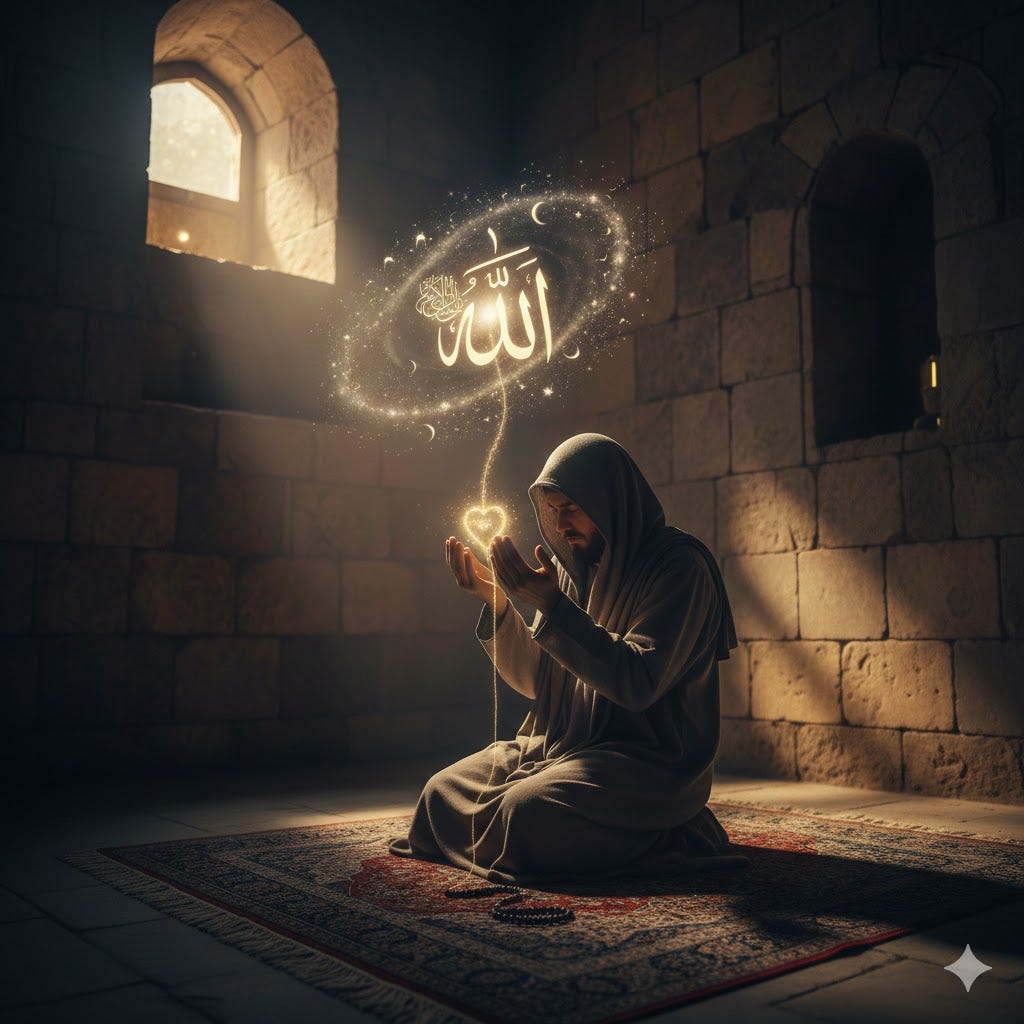
The Munajat of Shabaniyyah (The Whispered Prayer of Sha’ban) stands as one of the most profound spiritual treasures in the Shi’a tradition. It is a masterpiece of gnosticism (irfan), humility, and divine love, reported to have been recited by Imam Ali (AS) and all the subsequent Imams of the Ahl al-Bayt (AS).
Unlike many supplications that focus on specific worldly needs, this munajat is an intimate conversation centered entirely on the heart’s yearning for its Creator.
Origins and the Chain of Light
The prayer is documented by the master scholar Ibn Tawus in his seminal work, Iqbal al-A’mal. What makes this supplication unique is its universal practice. Imam Khomeini often highlighted that while most prayers are associated with a specific Imam, this is a rare instance where all the Imams (AS) were known to recite the same words, marking it as a unified anthem of their devotion.
The Core Philosophy: Total Detachment
At the heart of the munajat lies a plea for Kumal al-Inqita—the total severing of ties from everything other than Allah. The Imam (AS) prays:
“O Allah! Grant me total separation from everything else and total attachment to You... enlighten the eyes of our hearts with the light of their look towards You.”
This is the practical application of the Quranic command:
“And remember the name of your Lord and devote yourself to Him with [exclusive] devotion”
(Quran, Surah al-Muzzammil, Chapter 73, The Wrapped, Verse 8).
It teaches us that true freedom is found only when the soul breaks the chains of material dependency.
The Paradox of Hope and Unworthiness
The munajat provides a masterclass in the “spiritual psychology” of a believer. It navigates the tension between our realization of sin and our certainty in Divine Mercy.
The logic used is breathtaking: “If You take me to task for my sins, I will take hold of Your forgiveness; if You take me to the Fire, I will tell its inhabitants that I love You.” It suggests that even in the face of judgment, the servant’s weapon is their love for the Master.
Perspectives from the Maraje’
The great scholars of our time have viewed this prayer as an essential manual for self-purification (Jihad al-Nafs):
Ayatollah Ruhollah Khomeini: He famously stated that if one contemplates the meanings of the Munajat of Shabaniyyah, they would find the very essence of Tawhid (Monotheism). He regarded it as the essential gateway to the “Great Feast” of Ramadan.
Ayatollah Ali Khamenei: He has frequently urged the youth to recite this prayer to gain “spiritual focus,” noting that its expressions of humility are actually the highest forms of human dignity.
Allamah Tabatabai: The author of Al-Mizan viewed such supplications not just as “asking,” but as a method of “seeing” reality through the eyes of the Ma’sumin (AS).
Why Sha’ban?
The Month of Sha’ban acts as a bridge. The Prophet Muhammad (SAW) referred to it as “his month.” Reciting this munajat during this time serves a dual purpose:
Polishing the Heart: It removes the “rust” of worldly distractions.
Preparation: It tunes the soul to the “frequency” of the Holy Quran before the arrival of the Night of Destiny (Laylat al-Qadr) in the coming month of Ramadan.
The Fruits of the Munajat
When we recite these words, we experience three major shifts in our spiritual state:
Intimacy: Our relationship with God moves from a cold, formal obligation to a warm, “whispered” conversation between a lover and the Beloved.
Cognition: We begin to understand our own “existential poverty”—the fact that we are entirely dependent on Divine Light for every breath.
Peace: By emphasising God’s infinite generosity (Karram), the prayer relieves the crushing anxiety of our past mistakes.
As the Imam (AS) beautifully concludes:
“My God, if You had intended to humiliate me, You would not have guided me; and if You had intended to disgrace me, You would not have granted me safety.”