

A journey through the “Ya Man Arjuho” prayer, exploring the depths of Divine Mercy, the logic of hope, and the etiquette of asking the Creator.
The month of Rajab is a time of spiritual outpouring, anchored by the daily recitation of the supplication “Ya Man Arjuho likulli khair” (”O He from Whom I hope for all goodness”). Based on the insights of Imam Khamenei, this article breaks down the profound meanings within this prayer, guiding the believer from hope to salvation.
1. The Foundation: Hope and Safety
The supplication begins by establishing the believer’s stance before God: “O He from Whom I hope for all goodness...”
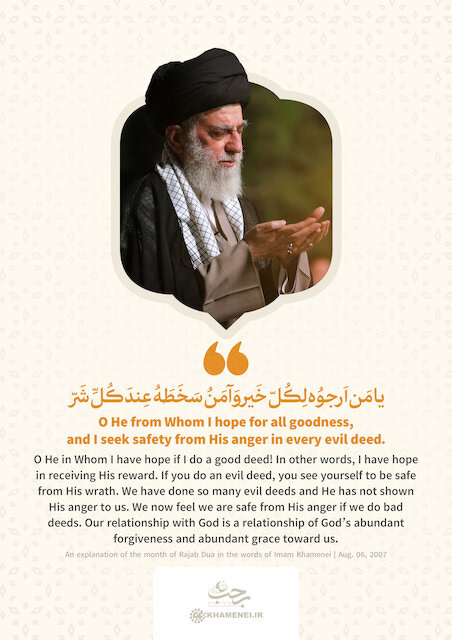
This opening declaration is about total reliance. It means, “O He in Whom I have hope if I do a good deed!” We hope for His reward. However, it also addresses our shortcomings. Imam Khamenei notes a profound psychological reality: even when we commit evil deeds, we often feel safe from God’s immediate wrath. This sense of safety doesn’t come from our own innocence—because we have done many evil deeds—but from the nature of the relationship itself. It is a relationship defined by God’s “abundant forgiveness and abundant grace toward us.”
2. The Great Exchange: Much for Little
We proceed to address God as: “O He Who gives much in return for a little”
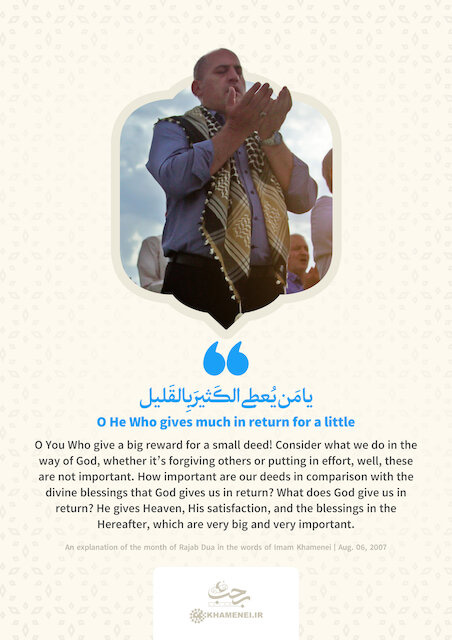
Here, we acknowledge the disparity between our efforts and God’s generosity. Imam Khamenei invites us to consider our actions—whether it is forgiving others or striving in the way of God. Ultimately, “these are not important” when compared to the return. How can human action compare to divine blessings? The return God gives is Heaven, His satisfaction, and the blessings of the Hereafter. It is a trade where the Creator gives infinite value for finite, small deeds.
3. The Promise of Answered Prayers
The prayer affirms: “O He Who gives to the one who asks Him”
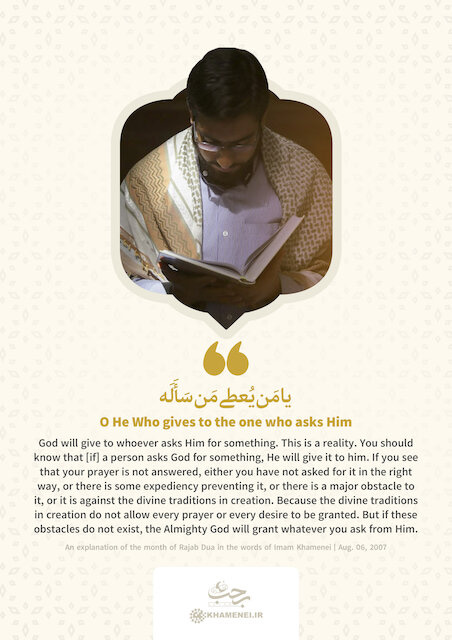
This is a statement of reality: God gives to whoever asks. However, Imam Khamenei addresses the common doubt: “Why is my prayer not answered?” He outlines four specific reasons why a request might be delayed or denied:
You may not have asked for it in the right way.
There is a specific “expediency” (a higher benefit) preventing it.
There is a “major obstacle” standing in the way of the request.
The request goes against “divine traditions in creation” (the natural or spiritual laws God has set). If these obstacles do not exist, the Almighty grants whatever is asked.
4. Grace Beyond Requesting
The generosity of God extends even to those who are silent: “O He Who gives to the one who does not even ask Him and does not know Him”
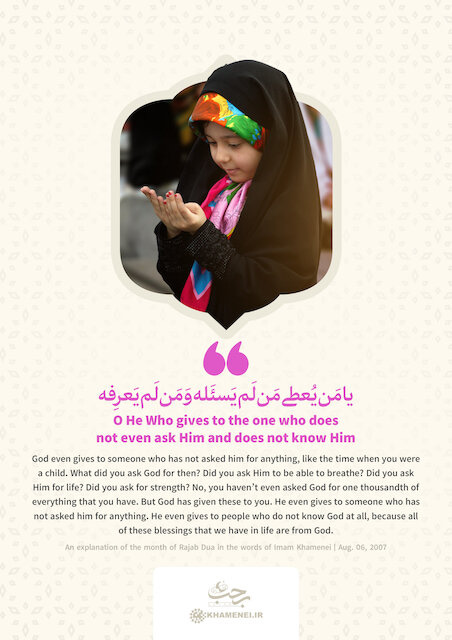
To illustrate this, Imam Khamenei uses the powerful analogy of childhood. When you were a child, did you ask God for the ability to breathe? Did you ask for life or strength? No. You had not asked for “even one thousandth” of what you possess. Yet, God provided these things. He gives even to those who do not ask, and even to those who do not know Him at all. All blessings in life originate from Him, regardless of the recipient’s awareness.
5. The Source: Compassion and Mercy
Why does God give to those who don’t even know Him? The supplication explains: “He gives due to His Compassion (Tahannon) and Mercy (Rahamah)”
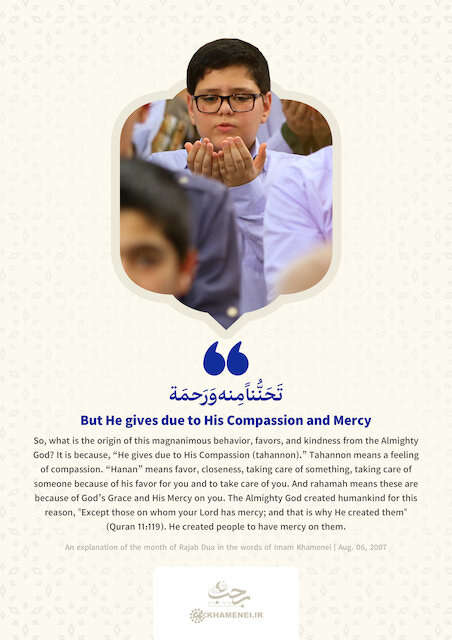
Imam Khamenei breaks down these terms. Tahannon refers to a feeling of compassion. Hanan implies favor, closeness, and taking care of someone out of affection. Rahamah refers to God’s Grace. Citing the Quran (Surah Hud, Chapter 11, Verse 119), the Imam reminds us of the fundamental purpose of creation: “Except those on whom your Lord has mercy; and that is why He created them.” God created human beings specifically to shower them with this mercy.
6. Asking for Everything
Emboldened by this knowledge, the supplicant makes their move: “Grant my request for all the good of this world and the Hereafter”
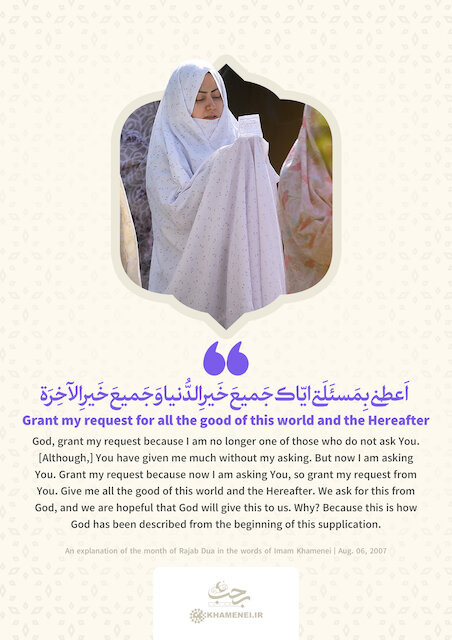
The logic here is profound. We say to God: You have given me so much without me even asking (as established in the previous lines). But now I am actively asking You. Therefore, grant my request. We ask for “all the good” of this world and the next. We are hopeful because the description of God in the beginning of the prayer (as the One who gives much for little) encourages us to aim for the ultimate prize.
7. Protection from Evil
The request continues: “Grant my request from You to keep away all the evil”
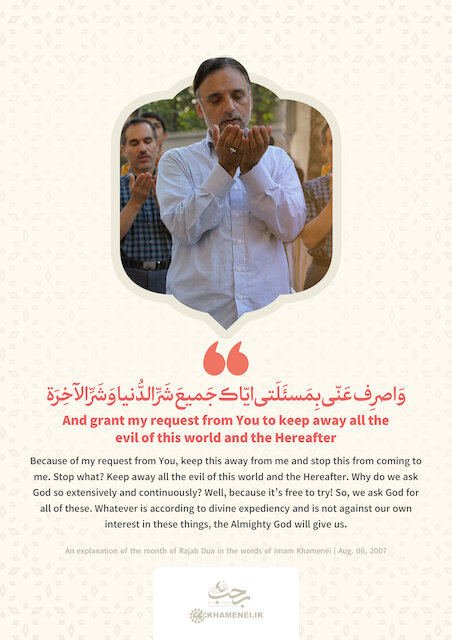
We ask God to stop evil from coming to us in both this world and the Hereafter. Imam Khamenei asks rhetorically, “Why do we ask God so extensively and continuously?” His answer is simple and practical: “Well, because it’s free to try!” We ask for everything, trusting that whatever aligns with divine expediency and our own best interests will be granted by the Almighty.
8. The Limitless Treasurer
We justify our extensive requests by saying: “For indeed, what is given by You does not have any lacks”
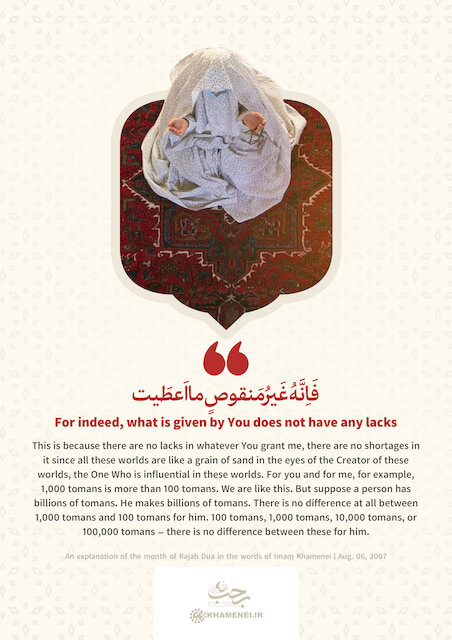
God’s giving does not deplete His treasury. Imam Khamenei uses a monetary example to explain our limited human perspective. To us, there is a big difference between 1,000 tomans and 100 tomans. But for a person with billions, the difference between 100, 1,000, or 100,000 is nonexistent. If a billionaire gives a small amount, it changes nothing for them. Similarly, all these worlds are like a “grain of sand” in the eyes of the Creator. Giving to us causes no “lacks” or shortages in His dominion.
9. The Final Plea: Salvation
The prayer crescendos with an appeal to God’s attributes: “O He Who is Majestic and Honorable... Save my grey beard from the fire [of Hell].”
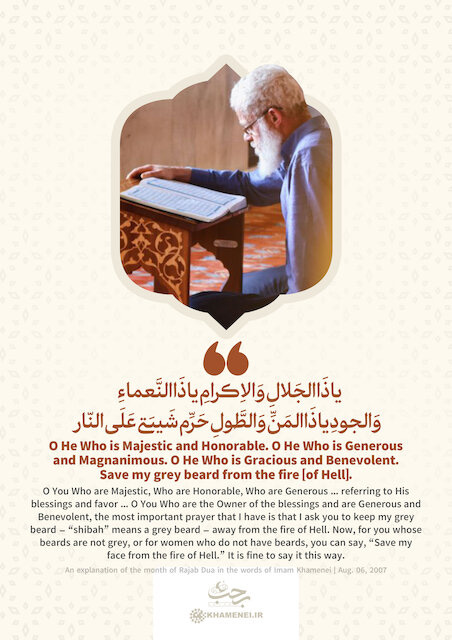
We appeal to the Owner of blessings, the Generous and Benevolent. The phrase “Save my grey beard” (shibah) is a metaphor for one’s physical being and dignity. Imam Khamenei clarifies that this is inclusive: for young people whose beards are not grey, or for women, the meaning is simply, “Save my face from the fire of Hell.” It is the most important prayer of all—preservation from spiritual ruin.
10. The Etiquette of Understanding and Gesture
Finally, Imam Khamenei discusses the physical and mental state of prayer: Endeavoring to understand the meaning.
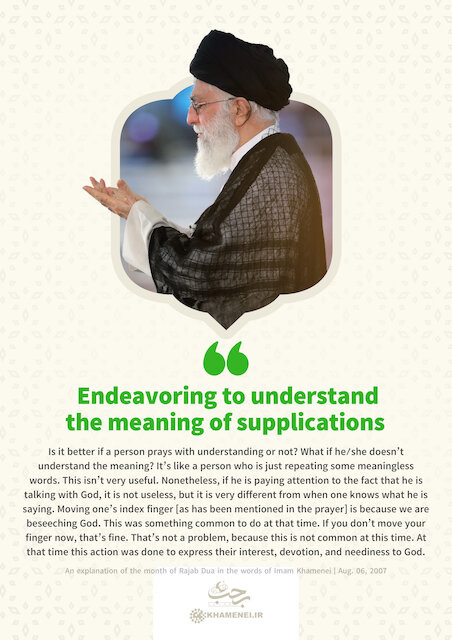
Is it better to pray with understanding? Yes. While repeating words without understanding is not “useless” (as it still shows an attempt to talk to God), knowing what you are saying transforms the experience.
Regarding the tradition of moving the index finger during this supplication: Imam Khamenei explains that this was a common gesture at the time of the Infallibles to express “interest, devotion, and neediness.” However, he notes that “if you don’t move your finger now, that’s fine.” It is not a problem if modern believers omit this gesture, as it is no longer common in our time. The core is the devotion, not just the motion.
Reference: The Official Website of Imam Khamenei