

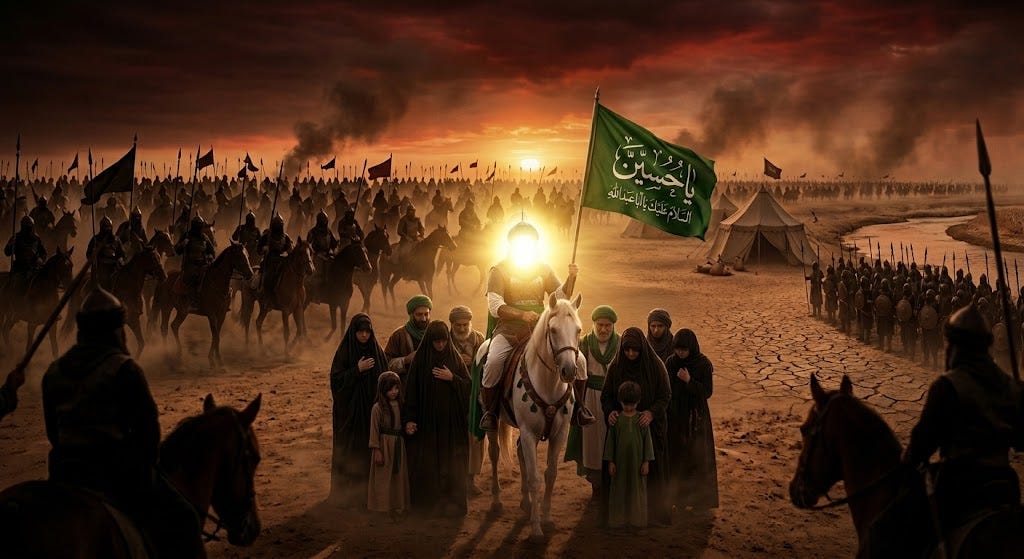
Every year, as the crescent moon of Muharram rises over the horizon, something ancient stirs inside the conscience of millions. Mosques fill before dawn. Streets ring with lamentation. Eyes that rarely weep are suddenly wet. And beneath all of it — beneath the black garments and the beating chests — pulses a question that no era has ever rendered obsolete:
What does a human being truly live for?
In a world addicted to distraction, this question feels almost unbearable. We pursue comfort, curate our image, accumulate and consume — and still find ourselves hollow at the core. Ashura cuts through this modern noise like a blade. It is not merely a season of mourning for the Ahl al-Bayt; it is a mirror held to the soul, asking us what we value enough to protect, to fight for, to bleed for.
The well-known maxim says it plainly: ”Islam is Muhammadan in its origin, and Husayni in its survival.” But to truly feel the weight of those words — to understand how Imam Husayn (peace be upon him) became the guardian of faith itself — we must first stand on the precipice over which Islam was about to fall.
The Beautiful Mask of a Hollow Religion
The danger confronting the Muslim world in 61 AH was not a frontal assault on the faith. It was something far more treacherous: the slow, surgical hollowing out of Islam’s soul while its outward shell remained polished and intact.
The Umayyad dynasty had transformed the sacred trust of the caliphate into a corrupt hereditary monarchy. But their most lethal project was theological. They bent the language of religion to legitimise their crimes. Oppression was rebranded as the maintenance of order. Silence before tyranny was praised as wisdom. Flattery of corrupt rulers became the highest mark of piety. And in perhaps their most devastating manipulation, the Umayyads weaponised the concept of divine decree — *qadar* — convincing the impoverished masses that their suffering was simply God’s unquestionable will, and therefore not to be resisted.
Imam Husayn saw this with devastating clarity. Had he pledged allegiance to Yazid — even in private, even under duress — that silence would have carried the weight of religious endorsement. The distortion would have calcified. The lie would have become holy tradition.
He said it himself, with the precision of a surgeon and the grief of a grandson:
”One may bid farewell to Islam when the Ummah becomes afflicted with a ruler like Yazid.”
This was not political grievance. It was a diagnosis. And Karbala was the only prescription left.
The Three Types of Human Beings
Across the sweep of history, human lives tend to orbit one of three centres. There are those who live for pleasure — spending the brief capital of their days in the pursuit of sensation and comfort. There are those who live for worldly success — measuring a life by its wealth, its status, its applause. And then there are those lit from within by something greater than themselves: a mission, a principle, a truth worth dying for.
Imam Husayn stands as the most breathtaking manifestation of that third kind of human being.
On the road to Karbala, with a small band of companions and a horizon full of enemy soldiers, he declared his purpose with a serenity that should shake us to our foundations:
”I have not risen out of vanity, arrogance, corruption, or oppression; rather, I have risen to seek reform in the community of my grandfather.”
Notice what is absent from that statement. No self-pity. No desperate bid for survival. Only a soul in perfect alignment with its purpose.
For the mission-driven human being, the value of life is never measured by its length. It is measured by its fidelity to truth. This is why Imam Husayn did not experience his impending martyrdom as defeat. In one of the most staggering declarations in the history of human conscience, he said:
”I see death as nothing but felicity, and life with oppressors as nothing but weariness and misery.”
A man who could speak those words was already free. Karbala could not defeat him, because he had already chosen his battlefield — and it was the battlefield of the soul.
The Plains That Shook the World
From every military calculation, Karbala was a disaster. Seventy-two souls against thousands. No reinforcements. No water — the Umayyad army had sealed the riverbank three days before battle, denying even the children of the Prophet’s household a single drop to drink. This was not merely war; it was the deliberate weaponisation of thirst against innocents.
Yet in choosing to fight rather than submit, Imam Husayn delivered a spiritual earthquake to a society paralysed by fear. The shedding of the Prophet’s grandson’s blood tore the mask from the Umayyad regime and shattered the suffocating culture of compliance that had gripped the Muslim world. He proved, in the most costly way imaginable, that truth is never determined by a headcount, and righteousness does not require a majority.
He had told them as much before the battle began:
”Someone like me cannot give allegiance to someone like Yazid.”
Study those words carefully. He did not say “I” and “Yazid.” He said *someone like me* and *someone like Yazid.* He was not making a personal statement. He was laying down a universal law for every generation that would come after — a timeless standard by which every collision between truth and power would be judged. Whenever conscience confronts corruption, that sentence echoes across the centuries.
The Voice That Carried Karbala to the World
The bodies of the martyrs had barely grown cold when the Umayyad army began its second campaign: the erasure of Karbala from history. They took the survivors — women, children, the sick — as prisoners and paraded them through cities as trophies.
They had not reckoned with Lady Zaynab (peace be upon her).
Dragged before the court of Yazid in Damascus, stripped of her freedom, surrounded by the men who had slaughtered her brother, her sons, her nephews — she stood and spoke. Not in grief. In fury. In a voice so precise and so devastating that Yazid’s propaganda crumbled before it. She named him for what he was. She refused every frame he tried to place around the massacre. She transformed prisoners into witnesses, and a courtroom into a tribunal.
Karbala might have been buried in desert sand, lost to centuries of silence, if not for one woman. Every tear shed in Muharram, every majlis attended, every Ashura observed — it was her voice that made it possible.
A community that silences its women has forgotten Lady Zaynab.
The Blood That Never Dries: Our Responsibility Today
”Every day is Ashura, and every land is Karbala.”
This is not poetry. It is a map.
The struggle Imam Husayn entered on the tenth of Muharram did not end when the last arrow fell. It is the same struggle that confronts anyone who has ever watched the weak crushed by the powerful and been asked, quietly, which side they stand on.
Mourning without transformation is not devotion — it is theatre. To claim love for Husayn while remaining indifferent to the poverty outside our mosques, the injustices in our cities, the corruption in our institutions, is to have understood nothing of Karbala.
The weaponisation of water at the banks of the Euphrates has a thousand modern faces: communities denied clean drinking water, families priced out of the basic necessities of life, the poor punished by the very systems designed to protect them. The followers of Husayn who fund clean water wells, support food banks, and campaign for housing rights are not simply doing charity — they are practising theology.
The Islamic principle of *Amr bil Ma’ruf wa Nahi ‘anil Munkar* — enjoining good and forbidding evil — was not a platitude to Imam Husayn. It was the reason he rose. In the workplace, in the courtroom, in the public square, this principle demands that we speak when it is uncomfortable, stand when it is costly, and name injustice even when the powerful have given it a respectable name.
The Prophet (peace be upon him and his family) said:
”The most excellent jihad is the speaking of a word of truth in the face of a tyrant.”
Imam Husayn lived that hadith on the plains of Karbala. Lady Zaynab carried it forward in the courts of Damascus. And now the word passes to us — in our schools, our community halls, our parliaments, our social media feeds, and every quiet space where we must choose between comfortable silence and costly truth.
We are not called merely to weep. We are called to act. To be Husayni is not simply to shed tears; it is to embody the fierce moral courage those tears represent.
The Question Ashura Will Not Let Us Answer Cheaply
As the drums fall quiet and the lamps of Muharram burn low, Ashura leaves us with one question it refuses to let us answer cheaply:
Is the purpose you are living for today truly worthy of your life?
Imam Husayn answered that question on the tenth of Muharram, 61 AH, in the dust of a desert plain, with his final breath.
He did not die so we could have ten days of beautiful grief and then return unchanged to our lives. He died so that we would know — in our bones, in our blood — that a human being fully alive to their purpose is worth more than a thousand souls sleepwalking through comfort.
Let your heart break for Karbala. Then let those broken pieces become the architecture of something just, something honest, something worthy of the name he gave us.
When writing on The Holy Prophet and his family one should be extremely careful choosing words being used. In the following quote "Karbala might have been buried in desert sand, lost to centuries of silence, if not for that woman" unquote you do not address the Honourable Lady Zainab as that women. Please correct it to read quote "Karbala might have been buried in desert sand, lost to centuries of silence, if not for the honourable and brave lady Zainab" unquote