

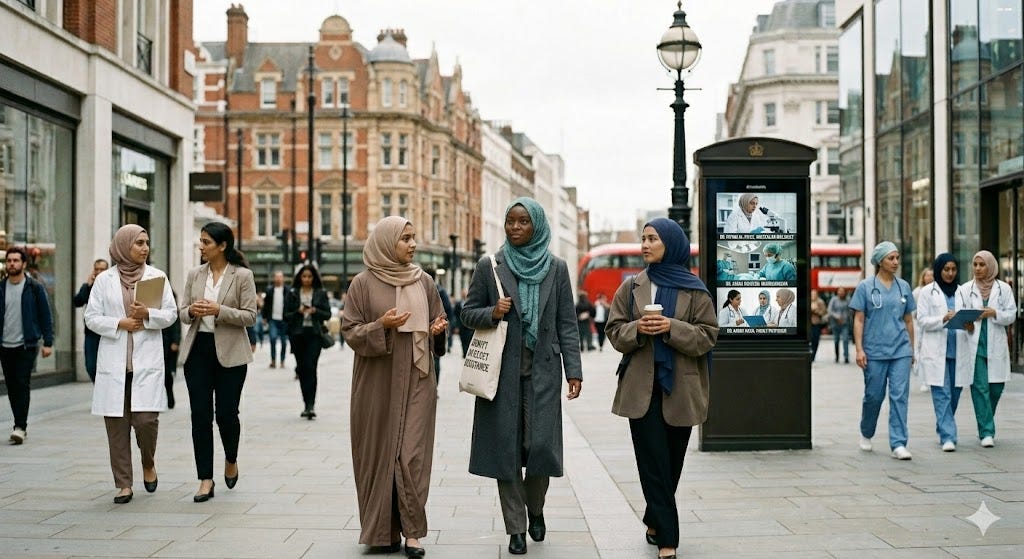
Across the globe—from the bustling streets of London and New York to the vibrant communities of Toronto and beyond—the modern Muslim woman navigates a world filled with complex expectations. In an era where her clothing is frequently the subject of political debate, media scrutiny, and cultural misunderstanding, the true essence of why she chooses modesty is often lost.
Honouring the Divine Commandment
For millions of Muslim women, the decision to wear the hijab is fundamentally rooted in faith and obedience to God’s command, as articulated in the Holy Quran. It is not merely a cultural tradition, but a spiritual commitment.
“And say to the believing women that they should lower their gaze and guard their modesty; that they should not display their beauty and ornaments except what (must ordinarily) appear thereof; that they should draw their veils over their bosoms and not display their beauty...”
(Surah an-Nur, Chapter 24, The Light, Verse 31)
This divine directive sets the foundation for modesty (haya) as a core value, establishing the hijab as a means of honouring that principle and achieving spiritual closeness to God.
The Illusion of Liberation
For decades, a pervasive narrative has dominated global media: the idea that the hijab is inherently restrictive, and that true “liberation” is achieved only by uncovering. But for millions of Muslim women living in diverse societies around the world, this definition of freedom feels not only narrow but deeply contradictory. When we look closely at modern societal standards, we must ask ourselves: is a culture that heavily pressures women to commercialise their physical appearance truly liberating?
Imam Ali ibn Abi Talib (AS) emphasised that true beauty is rooted in character and modesty, not outward display.
“The beauty of a woman is modesty.” (Nahj al-Balagha, Wisdom 227)
By choosing the hijab, Muslim women actively resist the societal pressure to be defined solely by their physical appearance.
Seeing Without Being Seen
The renowned anti-colonial thinker Frantz Fanon once wrote of the profound power of a woman who “sees without being seen.” For the Muslim woman today, the hijab represents exactly this: a conscious, empowering boundary.
By choosing to cover, she enters the public sphere on her own terms. She engages with her community, contributes to the economy, and builds relationships, but she actively denies the world the ability to reduce her to her physical form. She looks out into the world, clear-eyed and active, while protecting her body from the degrading, objectifying gaze of society. Her modesty is a profound declaration: My intellect, my character, and my voice are for public interaction; my physical form is my own.
In a world that has spent decades grappling with the objectification of women in the workplace, in media, and in social spaces, the hijab offers a powerful alternative. It is a protective fortress of dignity that allows a woman to be judged by the content of her mind rather than the shape of her body.
Progress and Modesty Hand in Hand
A lingering myth in some circles is that modesty somehow hinders a woman’s ability to progress. Yet, the reality of Muslim women worldwide shatters this misconception every single day. The exemplary life of Sayyida Fatima Zahra (SA), the daughter of the Prophet (S) and the epitome of dignity, serves as a timeless inspiration. She was deeply knowledgeable and influential, yet she maintained the highest standards of modesty and dignity.
It is reported that Sayyida Fatima (SA) said, “What is best for women is that they should not see men, nor should men see them [unnecessarily].” [1]
This perspective, often misunderstood, highlights a priority on privacy and self-worth, rather than restriction. It refutes the idea that a woman’s value is tied to her public visibility.
Following in her footsteps, modern Muslim women are thriving. They are not invisible. They are doctors leading groundbreaking medical research, engineers designing sustainable infrastructure, lawyers defending human rights, and educators shaping the next generation. They are winning global athletic medals, building thriving businesses, and holding public office—all while preserving their Islamic values and dress code. They are proving that faith and ambition are not mutually exclusive.
A Global Sisterhood of Dignity
The conversation around the hijab must shift from one of assumption to one of understanding. Whether she lives in the East or the West, the Muslim woman who embraces modesty is not taking a step backwards; she is taking a bold step forward. She refuses to trade her deeply held values and her hard-earned dignity for superficial validation.
Ultimately, the hijab is not a barrier to the world; it is a lens through which a Muslim woman defines her relationship with it. It is a daily, conscious choice to prioritise spiritual and intellectual worth over physical objectification. In a world obsessed with appearances, her modesty remains one of the most powerful forms of modern empowerment.
This tradition is found in various Shia hadith collections, such as Bihar al-Anwar by Allama Majlisi, highlighting the high status of privacy and dignity in the view of the Ahlulbayt (AS).